

Growing the timber industry means growing the timber resource
September 7, 2026
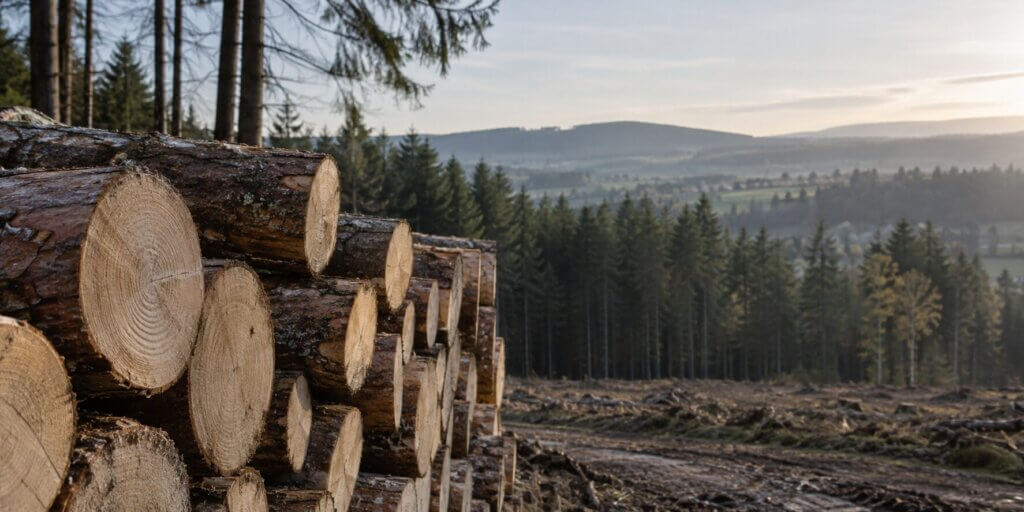
The England Forest Industries Leadership Group brings together senior leaders from across forestry and timber to tackle one of the sector’s biggest long-term challenges: how to grow demand for wood while ensuring England has the productive forests needed to supply it.
Government policy increasingly recognises the role that wood can play in lowering the carbon impact of construction, supporting rural jobs and creating more resilient domestic supply chains. The Government’s Timber in Construction Roadmap is explicit about the opportunity to increase the use of timber in new homes and other buildings, and identifies increasing the sustainable supply of timber as one of its seven priority themes.
But increasing demand is only half of the equation.
If we want to use substantially more timber in the decades ahead, we must also make sure that our forests can produce enough of the right timber to supply those markets.
That is one of the central challenges being addressed by the England Forest Industries Leadership Group (EFILG).
What is EFILG?
EFILG is an invitational group bringing together senior leaders from across England’s forestry, timber processing and wood-using industries, alongside representatives from Government and the Forestry Commission.
The group was established following an action in the National Wood Strategy, initially with a remit to help drive and monitor delivery of the Strategy’s 73 actions.
The National Wood Strategy was published in 2023 to set out a route towards increasing the growing, harvesting and production of timber in England, within an expanding network of multifunctional woodlands that balance the needs of society, the economy and nature.
Much has moved forward since then. The Government has published the Timber in Construction Roadmap, the policy landscape around forestry has developed and Forest Research has produced an important new 50-year forecast of future softwood availability.
EFILG is consequently evolving too.
Rather than simply monitoring a long list of individual actions, the group is increasingly concentrating on a small number of strategic issues where collective industry leadership can make a measurable difference.
At its August 2026 meeting, four areas emerged as the focus for that work.
-
Increasing England’s productive conifer resource
The most urgent issue is the decline of England’s productive conifer forests.
Conifers matter because they provide the overwhelming majority of the timber used by the British wood-processing industry. Around 92% of the wood consumed by UK processors is softwood, according to the National Wood Strategy.
Softwood from species such as spruce, pine, Douglas fir and larch is the backbone of high-volume timber production and, in particular, the construction timber market.
Broadleaved trees and hardwood production remain an important part of a diverse and productive forestry sector, but if Britain wants to significantly increase timber use in construction, the scale of our future softwood resource cannot be ignored.
And the direction of travel is concerning.
England has lost approximately 80,000 hectares of conifer woodland since 2000. Recent woodland creation has been dominated by broadleaves, with only a small proportion of new planting being conifer.
The new Forest Research 50-year softwood availability forecast makes the issue more immediate. While the GB resource remains comparatively strong over the next 25 to 30 years before declining, England faces a much earlier contraction. Softwood availability in England is forecast to fall from around 4.2 million cubic metres to approximately 2.3 million cubic metres, with private-sector availability falling by more than half.
Those figures matter.
England already imports substantial quantities of timber. At the same time, Government policy is seeking to expand timber construction and stimulate greater demand.
If those ambitions succeed without corresponding investment in productive forestry, a growing proportion of that additional demand will inevitably have to be met from overseas.
EFILG therefore wants to see a significant increase in productive woodland creation, alongside better restocking, improved tree breeding and greater productivity from the forests we already have.
-
Strengthening the public and political narrative
There is also a communication problem.
Productive forestry is sometimes portrayed as being in conflict with environmental objectives. In reality, well-designed productive forests can form part of multifunctional landscapes delivering timber, carbon storage, biodiversity, recreation, employment and economic activity.
The National Wood Strategy deliberately takes this broader view: increasing timber production within woodlands managed to balance the needs of nature, society and the economy.
EFILG believes the forestry and timber sector needs to explain that case much more confidently.
A particular focus is the next iteration of the England Trees Action Plan.
The group’s position is straightforward: productive forestry and domestic timber supply must have a clear and visible place within England’s future tree-planting policy.
Tree planting numbers alone do not tell us whether we are creating the future timber resource the country will need. What we plant, where we plant it and how those woodlands are subsequently managed matter too.
Encouragingly, Defra reported to EFILG in August that timber-sector feedback on the developing Trees Action Plan had strongly emphasised timber production and timber security, and that productive woodland encompassing both softwood and hardwood species was being considered within the emerging policy.
EFILG will continue to make the case for productive forestry as that work develops.
-
Building a stronger evidence base
Good policy depends on good evidence.
The forestry debate contains plenty of data, but it is often fragmented, difficult to interpret or presented without sufficient context.
EFILG therefore wants to develop a more credible and accessible evidence base around issues including timber supply and demand, woodland economics, land values, species choice, investment and processing capacity.
The aim is not necessarily to create more statistics. It is to turn the considerable amount of information already held by Forest Research, the Forestry Commission, processors and the wider industry into clear, decision-ready evidence that Government, investors and others can use with confidence.
The new 50-year softwood forecast is a good example. On its own, it tells us something important about future timber availability. The next step is to use that information to answer bigger strategic questions.
How much domestic timber do we want Britain to produce?
What processing industry do we want to retain and grow?
How much productive woodland will be needed to support it?
And what decisions do we need to take now if trees planted today are to contribute to timber supply several decades from now?
-
Strengthening and protecting markets for home-grown timber
There is another side to the equation.
There is little point creating a larger productive forest resource if there are not strong markets for the timber those forests produce.
EFILG therefore sees an important role in supporting increased use of home-grown timber and identifying policy or regulatory changes that could inadvertently undermine existing or developing markets.
Construction is particularly important.
The Government’s Timber in Construction Roadmap recognises timber as a renewable, low-carbon material and seeks to increase its use in buildings. Government also expects greater timber demand to stimulate investment in tree planting, forest management and domestic processing.
That creates a potentially powerful cycle:
strong timber markets encourage investment in forests; productive forests provide timber for industry; timber construction helps reduce embodied carbon; and growing demand supports further investment in the domestic supply chain.
Policy needs to reinforce that cycle rather than inadvertently work against it.
Recent discussions around possible changes to Approved Document B and fire regulations illustrate why EFILG believes the industry needs a stronger strategic voice. At its August meeting, members highlighted the potential conflict between policies intended to increase timber construction and regulatory changes that could constrain established timber applications.
Turning private investment into trees in the ground
EFILG is also seeking practical solutions rather than simply calling for more public funding.
There is considerable private investment capital interested in productive forestry. The question is why more of it is not currently resulting in woodland creation in England.
Through the EFILG Investor Forum, forestry investors have been able to put those barriers directly to Government.
Following discussions with the Forestry Minister, a focused Investment Task Group has received ministerial endorsement. The intention is to bring investors and the forestry industry together with Defra, the Forestry Commission and Natural England to tackle practical obstacles including investment certainty, land identification, regulatory coordination and the handling of larger woodland creation schemes.
This is exactly the sort of role EFILG should play: bringing together people with the knowledge, influence and ability to turn strategic ambition into practical change.
Joining up forestry and timber policy
For too long, discussion about planting trees and discussion about using timber have sometimes taken place in separate rooms.
They are two ends of the same supply chain.
The National Wood Strategy set out the industry case for expanding England’s productive timber resource. The Timber in Construction Roadmap sets out Government’s ambition to increase timber use. And the new 50-year softwood availability forecast provides increasingly clear evidence of the challenge facing future domestic supply.
EFILG’s job is to help join those pieces together.
We need more woodland in England for many reasons. But within that expanding woodland resource we also need sufficient productive forests capable of supplying timber to future generations.
The trees that will supply our sawmills and construction industry in 2050, 2060 and beyond need to be planted long before then.
That makes productive forestry not simply an issue for today’s timber industry, but a long-term question about what kind of forestry sector, manufacturing industry and low-carbon economy we want England to have in the future.