

Restoring the Water Wheel at Dunster Castle
At the edge of Dunster Castle, the historic watermill sits where it has for centuries, powdered by water flowing from the River Avill.
The wheel that came down had been there for 25 years. Oak doesn’t last forever, and this one had reached its limit. Naturally decayed and no longer safe for milling, it had to go.] For the National Trust, keeping working heritage like this alive matters. The buildings and the machinery are an integral part of the story.
When the time came to restore the mill’s water wheel, specialist contractor Ian Clark Restoration was appointed to undertake the work using British oak supplied by Vastern Timber.
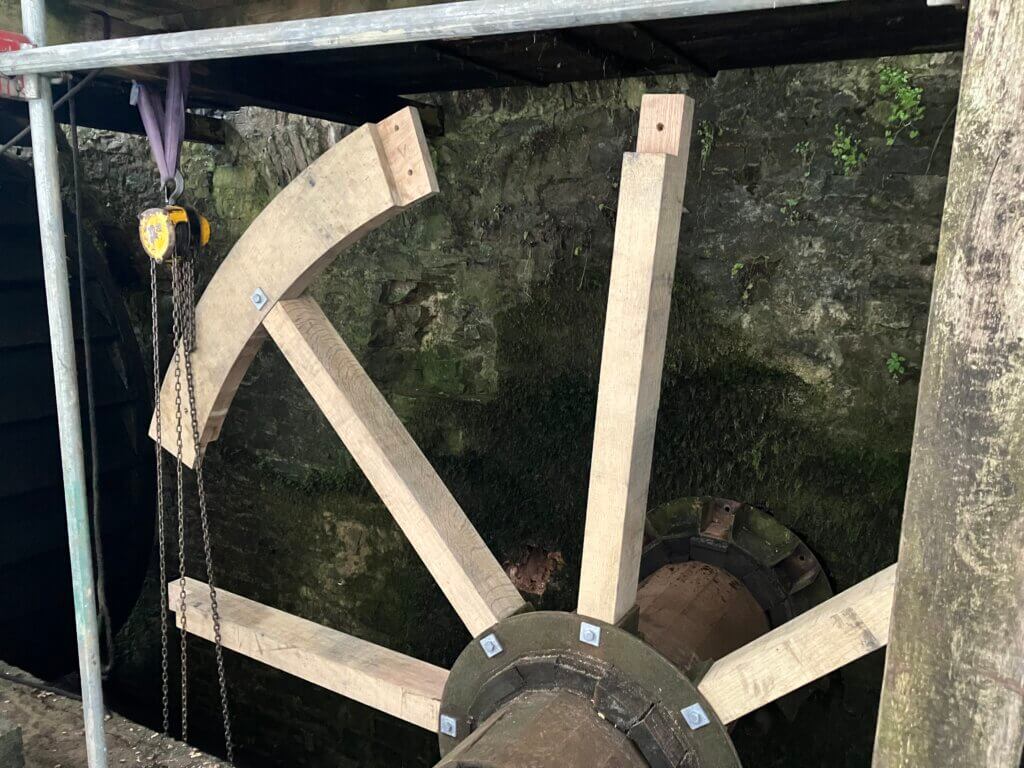
Rebuilding a working overshot water wheel
The replacement wheel follows the traditional overshot design, where water enters at the top and gravity drives the wheel as it fills the buckets.
Key specifications:
Diameter: 3.6 metres
Width: 1.2 metres
Material: British oak
Total oak used: 3 tonnes
Buckets: 40
Construction time: around 500 hours
Overshot wheels like this are efficient and historically accurate for many British mills. They rely on careful balance and precise joinery. Every component must work together while standing up to constant exposure to water.
The component parts of the new wheel weighed three tonnes in total. That’s where oak earns its place.
Why oak still matters in heritage engineering
The choice of timber for a waterwheel generates more debate than you might expect. There are tropical hardwoods that perform well technically. But on a heritage project, technical performance is only part of the picture. You also have to consider tradition, ethics and curatorial responsibility.
Oak has been used in watermills for centuries. Not because it was fashionable, but because it works.
Its natural durability and structural strength allow it to perform in wet environments for decades. When properly detailed, it can handle both the mechanical stresses of rotation and the continual cycle of wetting and drying.
Other British species appear in waterwheel work too. Elm, larch, sweet chestnut, apple and hornbeam all have their place depending on the component and the context. But for a heritage project like Dunster, oak preserves the character of the original machinery.
Using British timber keeps that story intact.

Craftmanship behind the wheel
Building a wheel of this size is a mix of engineering and traditional woodworking. But the biggest challenge on a live waterwheel project isn’t the joinery. It’s the water.
Working on a live site means constructing site-specific dams and managing all environmental risk carefully. Watercourses carry wildlife. Habitats need protecting. Heritage sites add another layer too. Material handling and logistics, straightforward on a standard build, become a puzzle when access is restricted and the setting is protected. The team adapted traditional manual handling and lifting methods to suit the conditions.
Construction used half-lap joints at the rim and spoke connections, with buckets carried on profiled starts, all fastened with hot zinc galvanised fixings. The liner boards are profiled to the internal radius and jointed with oak tongue and groove, eased with tallow.
During installation, the team worked inside the confined mill structure to assemble and secure the wheel around the oak axel-tree. The 16 shroud (curved) pieces and 16 spokes were lifted into place and carefully aligned before the buckets were fitted.
Projects like this demand patience as much as skill.
Supply timber for unusual project
Most of the timber supplied by Vastern Timber ends up in buildings as flooring, cladding, joinery and structural beams.
But through our Studley sawmill, we also support specialist work with timber for historic buildings, boats and bridges. Each project is different and that’s part of the appeal.
Historic machinery. Bridges. Restoration pieces. One-off engineering components. Each project is different. And that’s part of the appeal.
A working piece of history
The oak is left untreated, with all joints allowed to swell and expand to provide increased water retention. With regular operational maintenance, the wheel is expected to give 25 years of service. Exactly the same lifespan as the wheel it replaced.
Watermills like the one at Dunster remind us how much engineering once relied on timber.
When restored properly, these machines continue doing what they were built to do hundreds of years ago – quietly converting flowing water into mechanical power.
Thanks to careful craftmanship and durable British oak, the wheel at Dunster Castle will keep turning for many years to come.
Project cost: £58,000, fully inclusive of all professional fees, materials, logistics and scaffolding.